

Many CNC machining buyers split their supply chain across multiple suppliers. Machining sits with one vendor, finishing with another, and logistics sits in between. On paper, this can appear cost-effective. In practice, it introduces risk at every stage of delivery.
Each additional supplier creates another handoff, another schedule, and another point where something can go wrong. For procurement, engineering, and operations teams, that risk rarely appears in the initial quote. It shows up later in delays, rework, and internal pressure.
When machining, finishing, and delivery are split across multiple suppliers, each interface introduces risk in communication, timing, and accountability.
Fragmentation does not just add complexity. It multiplies failure points.
This article explains where CNC machining supply chain risk actually sits, why fragmented supplier structures create delays and rework, and how a one-stop shop approach reduces that risk by removing unnecessary handoffs, aligning processes, and creating clear accountability from start to finish.
Key takeaways
- Fragmented supply chains increase risk through misalignment, unclear accountability, and transit exposure.
- Consolidating machining and finishing creates a single point of accountability and a controlled delivery plan.
- Procurement benefits from reduced admin, clearer documentation, and more defensible supplier decisions.
- Consolidation is most valuable for tight tolerances, critical finishes, and repeat production work.
Want to discuss the advantages of a one-stop shop?

The hidden risk of fragmented CNC machining supply
A fragmented supply chain often looks efficient at the quoting stage. Each process is sourced separately, sometimes at competitive rates, and the overall cost appears controlled.
The issue is that this structure assumes each supplier will operate independently without affecting the next stage.
In reality, the interfaces between suppliers are where problems begin.
A part may be machined on time, then delayed at finishing. A secondary treatment may alter a critical feature because finishing requirements were not fully aligned with machining. Parts may be damaged or delayed in transit between suppliers. When issues arise, responsibility is often unclear.
This creates delays while teams investigate, assign ownership, and decide next steps. What initially looked cost-effective starts to generate internal workload, extended lead times, and avoidable friction.
Where CNC machining supply chain risk actually sits
Risk between suppliers
When machining, finishing, and delivery are handled by separate suppliers, responsibility is divided. Each supplier focuses on their stage, but no single party owns the final outcome.
If a problem appears, responsibility can become unclear. This often leads to delays while issues are investigated and resolved across multiple parties.
Risk between processes
Risk also sits between machining and finishing.
A part may be machined correctly but move out of tolerance after anodising or coating because finishing requirements were not aligned with the original machining strategy. Surface condition, masking, and feature sensitivity can all affect the final result.
When these considerations are not planned together, issues often only become visible after processing is complete.
Risk between schedules and delivery
Each supplier operates to their own schedule.
If machining is delayed, finishing may lose its allocated slot. If parts are delayed in transit, downstream processes are pushed back. These scheduling gaps introduce uncertainty and make delivery harder to predict.
Risk does not sit within any single supplier. It sits in how those suppliers connect.
The more disconnected the process, the more responsibility shifts to the buyer to manage those gaps — and the more exposure that creates.
What consolidation changes
A one-stop shop approach changes the structure of responsibility.
Instead of coordinating multiple suppliers, one partner manages machining, finishing, and delivery as a single, controlled process. This creates a unified production plan where each stage is aligned from the beginning, rather than adjusted later.
Machining decisions are made with finishing requirements in mind. Timelines are coordinated across the full process. Inspection criteria are consistent from start to final delivery.
The practical impact is clear. Communication is simplified because there is one point of contact. Issues are identified earlier because the full process is visible. Accountability is defined because responsibility does not pass between suppliers.
This is not about convenience. It is about controlling how parts move through the manufacturing process so that risks are managed before they affect delivery.
Why this matters for procurement
Procurement is responsible for decisions that must hold up over time, not just at the point of purchase.
When multiple suppliers are involved, each additional interface increases the likelihood of issues that procurement must resolve, explain, and justify internally. Delays, quality issues, or misalignment between suppliers often come back to procurement to manage.
Consolidation reduces that burden.
It creates a clearer structure for supplier performance, with one partner responsible for the final delivered part. Documentation becomes more consistent, communication is more direct, and accountability is easier to establish.
This makes day-to-day supplier management more predictable.
It also makes decisions easier to defend. When one supplier owns the full process, it becomes simpler to explain how risk is being controlled, how delivery is managed, and where responsibility sits if something goes wrong.

When consolidation makes sense
A one-stop shop approach delivers the most value when coordination risk is high and the cost of failure is significant.
In practice, consolidation is most beneficial when:
- Tolerances are tight and finishing can affect critical features.
- Surface finish or cosmetic requirements must remain consistent across batches.
- Lead times are compressed and delays cannot be absorbed downstream.
- Volumes are repeatable and consistency matters over time.
- Documentation, traceability, or compliance requirements must align precisely.
In these situations, separating machining and finishing increases the likelihood of rework, delays, or specification drift.
For lower-risk components, where tolerances are wider and finishing requirements are less critical, a fragmented approach may still be workable.
The key is not whether consolidation is always better, but whether the risk introduced by fragmentation is acceptable for the specific application.
Work with a one-stop shop for your CNC supply chain.
Fewer interfaces, fewer variables
Every supplier added to a supply chain introduces another variable: a separate schedule, a separate interpretation of the specification, and another point of handoff where issues can occur.
As the number of suppliers increases, so does the number of failure points the buyer must manage.
When suppliers are consolidated, those variables are reduced. Fewer interfaces mean fewer opportunities for misalignment, fewer delays, and fewer issues to resolve.
A one-stop shop is not about convenience. It is about reducing variables and increasing control over the outcome.
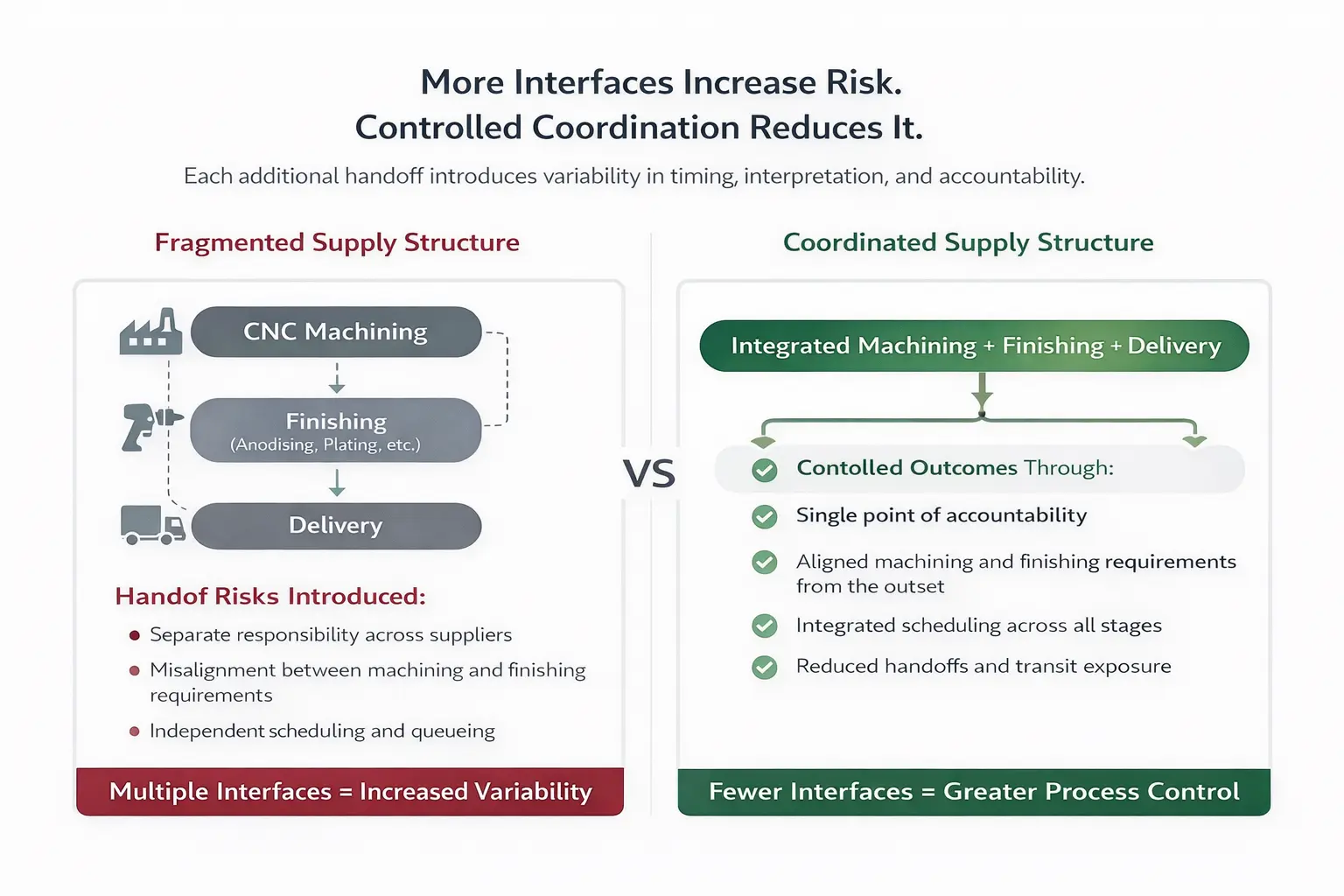
Each additional handoff introduces variability in timing, interpretation, and accountability.
Benefits of using a one-stop shop in CNC machining
Single source manufacturing, or what we call a 'one-stop shop', reduces risk by removing supplier interfaces and placing full responsibility for delivery, quality, and coordination with one partner.
When a single supplier manages machining, finishing, and delivery, the process becomes simpler and more predictable.
Key benefits include:
- Fewer delays because there are no gaps between suppliers
- Less rework because machining and finishing are aligned from the start
- Clear accountability for the final delivered part
- Reduced need to coordinate transport and schedules between suppliers
- Consistent interpretation of specifications across all stages
- Lower administrative workload for procurement and operations
- Faster resolution of issues because responsibility is not shared
The broader benefit is control.
Instead of managing a chain of suppliers, the buyer works with one partner who is responsible for delivering the final part to specification and on time. For teams managing complex supply chains, this often removes the majority of avoidable delays and significantly reduces day-to-day coordination effort.
Simplify your supply chain today.

Conclusion
The truth about CNC machining supply chain risk is that it's often created by fragmentation.
When machining, finishing, and delivery are split across multiple suppliers, the buyer becomes responsible for coordinating the process and managing the gaps between them. Each additional interface introduces more complexity, more uncertainty, and more potential for failure.
Consolidation addresses this by reducing interfaces and creating a single point of accountability.
For procurement, engineering, and operations teams, this leads to more predictable performance, clearer communication, and a supply chain that is easier to manage and defend internally.
CNC machining supply chain risk: How a one-stop shop reduces delays and improves control
Common questions
More resources
The limitations of data sheets for CNC machined component design
When it comes to CNC machining, data sheets are often relied upon by designers to guide their decision-making process. However, they do have their limitations in the context of CNC component design. Learn about these limitations and how to overcome them.