
If you are sourcing CNC machined parts in the UK, the question is straightforward: how long will it take? Realistic planning matters. Prototype work can often move within a few weeks, depending on geometry andfinishing. New production orders, however, typically sit in a 5–7 week window from order to delivery, and 8+ weeks is not unusual once scheduling, inspection and finishing are factored in.
Lead time is rarely constrained by spindle time alone. It is driven by production scheduling, queue position, finishing coordination and documentation control. If you want to reduce it in a sustainable way, the most effective lever is not repeated expediting. It is moving repeat parts onto a structured buying pattern such as scheduled orders, call-off against a blanket order, or Kanban replenishment. The sections below explain why.
Key takeaways
- Prototypes can move faster than production, but geometry, tolerances and finishing still drive calendar time.
- Most new production work is typically 5–7 weeks, and 8+ weeks is common depending on material, finishing and shop capacity.
- The most reliable way to improve lead time is repeat ordering under a scheduled, call-off or Kanban model.
- Lead time risk usually comes from capacity, finishing stages, drawing readiness and change control.
- Delays are often caused by rework loops: unclear specifications, late drawing revisions or incomplete documentation.
Share your drawing and target date for a realistic lead time check
Typical UK CNC machining lead times
The ranges below reflect common UK practice for precision machined parts — including complex CNC milling and multi-axis components — with finishing and standard documentation requirements.
These lead times apply across both precision CNC turning and milling work, including billet and bar-fed production parts.
Why these ranges are realistic
Production lead time is determined far more by queue position, production scheduling discipline and finishing coordination than by pure machining hours alone. A part may take only hours to machine, but it must be programmed, fixtured, inspected, potentially finished, and slotted into an existing production plan. This is why small and large batches often sit in similar calendar brackets. The difference is machining duration, not necessarily the overall delivery window.
Suppliers operating with a defined, repeatable process — from estimation through preparation and inspection — are typically better positioned to deliver consistent lead times without last-minute disruption.

The fastest way to reduce lead time: move repeat parts onto a buying pattern
If the lead times above feel longer than expected, the key question is not how to machine faster. It is how to structure supply more intelligently. If you regularly order the same parts, the most effective way to shorten and stabilise delivery is to move away from one-off purchase orders and adopt a repeat buying pattern.
Repeat demand allows capacity to be planned and slotted in advance. It reduces admin friction, minimises re-quoting, and avoids joining the queue from scratch each time. One-off ordering, by contrast, means each purchase order must take its place within the live workshop schedule at that point in time. The manufacturing knowledge may already exist, but the job still competes for available capacity alongside all other scheduled work.
Common approaches include:
- Scheduled orders with pre-agreed quantities and delivery dates.
- Call-off against a blanket order with agreed commercial terms.
- Kanban replenishment with defined trigger points and pack quantities.
To make this work, you need stable revision control, a clear forecast or cadence, agreed pack quantities, and defined release rules.
If you have repeat parts, ask about scheduled, call-off or Kanban options.
What slows CNC lead times down (and what to do instead)
Most delays are process-driven rather than machine-driven. Common causes include:
- Late drawing changes → Freeze the drawing revision before placing the order and agree a formal change process.
- Over-tight tolerances on non-critical features → Early design for manufacture (DfM) review often prevents unnecessary tolerance tightening and downstream delay.
- Unclear finishing requirements → Specify finish type and cosmetic acceptance criteria at quotation stage.
- Material uncertainty → Confirm exact grade and availability before order placement.
- Incomplete order information → Include PO number, drawing issue, quantities and certification requirements clearly.
- Inspection scope not agreed → Confirm whether CMM reports or FAIR documentation are required and in what format.
- Multiple suppliers for machining and finishing → Where possible, consolidate under a single accountable production plan.
We're ready to help you with your project.

Can CNC parts be turned around quickly?
Quick turn CNC is sometimes possible for simple prototypes or parts without complex finishing. However, for production work, calendar lead time is typically constrained by scheduling windows and finishing coordination.
If your production parts are consistently urgent, the underlying issue is usually planning structure rather than machining speed. Compressing production repeatedly increases risk elsewhere in the process. If your target date is immovable, realistic options include:
- Split deliveries so critical parts arrive first.
- Simplifying or deferring finishing where function allows.
- Prioritising critical features and agreeing inspection scope early.
- Moving repeat work onto a scheduled or call-off model to avoid queue resets.

Conclusion
CNC machining lead time in the UK is rarely about spindle time alone. It reflects production scheduling discipline, inspection requirements, finishing coordination and documentation control. In practice, stable planning structures shorten lead time far more reliably than repeated expediting. For repeat parts, structured buying patterns are the only dependable way to shorten and stabilise lead times without increasing risk elsewhere in the process.
If you want clarity on your specific part, share the drawing and required delivery date and we will confirm what is achievable.
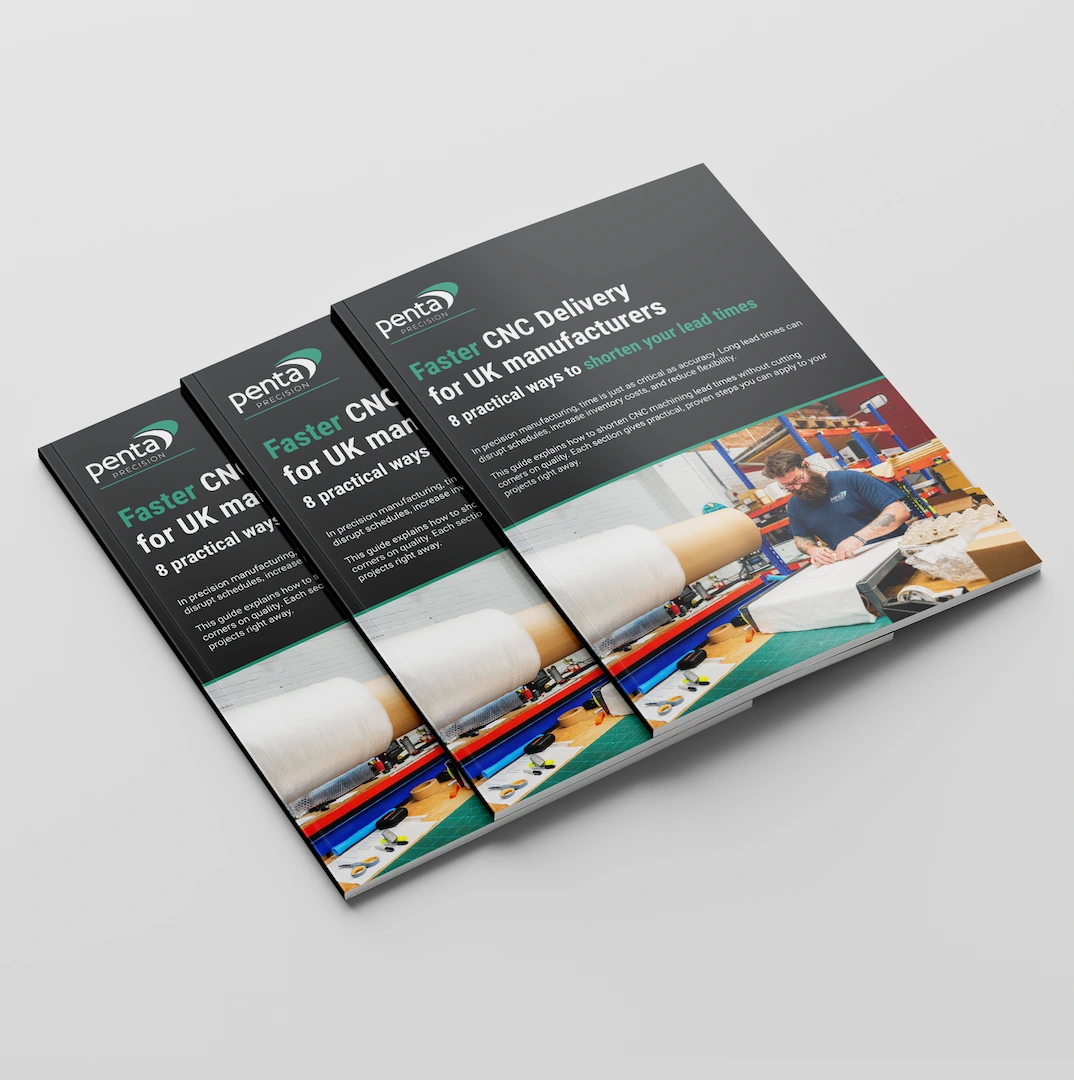
Want a step-by-step guide to faster CNC delivery lead times?